
Appearance
Services
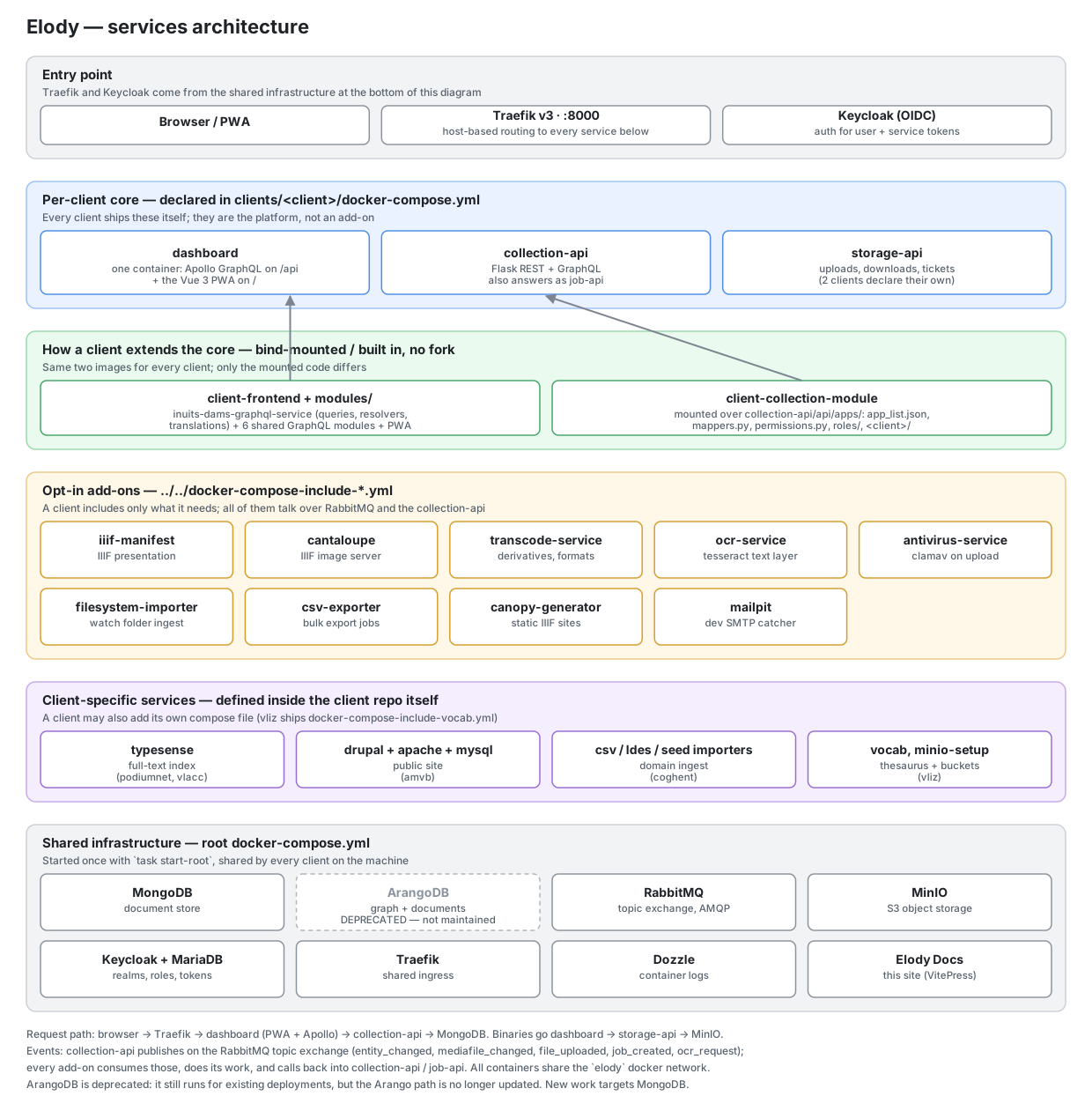
Elody Common is a microservice platform. This section documents each service and the features it exposes.
- Elody Collection — the Flask REST + GraphQL API backing entity storage, filtering, and relations.
- Elody Frontend — the Vue 3 PWA that renders the GraphQL-driven UI.
How a deployment is composed
A running Elody environment is assembled from four layers.
Shared infrastructure (docker-compose.yml in the repository root) is started once per machine with task start-root and shared by every client: Traefik, Keycloak + its MariaDB, MongoDB, ArangoDB, RabbitMQ, MinIO, Dozzle and this documentation site.
ArangoDB is deprecated
The ArangoDB path is no longer maintained. The container still runs so existing deployments keep working, but it does not receive updates and new work targets MongoDB. Do not pick DB_ENGINE=arango for a new client.
The per-client core is declared inline in clients/<client>/docker-compose.yml. It is never an include, because every client needs it:
| Service | Notes |
|---|---|
dashboard | One container serving two things: the Apollo GraphQL server on PathPrefix(/api) and the Vue 3 PWA on PathPrefix(/). |
collection-api | Flask REST + GraphQL. Also carries the job-api network alias and Traefik router, which is what the add-on services call for job tracking. |
storage-api | Uploads, downloads and tickets against MinIO. Usually pulled in via docker-compose-include-storage-api.yml, but digipolis-asset-engine and pza-iot declare their own. |
Opt-in add-ons live in docker-compose-include-*.yml at the repository root. A client includes only the ones it needs. They communicate over the RabbitMQ topic exchange and call back into collection-api / job-api.
Client-specific services are declared inside the client repository itself. A client can also ship its own include file — vliz-dams provides docker-compose-include-vocab.yml next to its compose file.
How a client extends the core
Every client runs the same two core images. Only the mounted code differs, so there is no fork of collection-api or the PWA.
- Backend —
clients/<client>/client-collection-moduleis bind-mounted overcollection-api/api/apps/:app_list.json,mappers.py,permissions.py,roles/and a<client>/package holding the object configurations and validators. - Frontend —
clients/<client>/client-frontendsupplies theinuits-dams-graphql-service(queries, resolvers, translations, schema). It is combined at build time with the six shared GraphQL modules inmodules/(baseGraphql,advancedFiltersModule,advancedSearchModule,importModule,mediafileModule,savedSearchModule) and theinuits-dams-pwasource.
Which client runs what
inc = pulled in through the shared include file, own = declared in the client's own compose file.
| Client | iiif + cantaloupe | storage-api | transcode | ocr | antivirus | filesystem-importer | csv-exporter | canopy | mailpit | Client-specific |
|---|---|---|---|---|---|---|---|---|---|---|
| amvb-dams | inc | inc | inc | inc | inc | drupal, apache, mysql | ||||
| coghent-dams | inc | inc | inc | csv-import, ldes-import, data-seed, image jobs | ||||||
| digipolis-asset-engine | inc | own | inc | — (headless, no dashboard) | ||||||
| digipolis-dams | inc | inc | inc | inc | inc | inc | inc | — | ||
| dishacled-wp3-prototype | — (collection-api + dashboard only) | |||||||||
| hairoad-elody | inc | inc | inc | inc | — | |||||
| podiumnet | inc | inc | inc | inc | inc | typesense | ||||
| pza-iot | inc | own | — | |||||||
| ugent-aicap | inc | inc | own | — | ||||||
| vlacc-dams | inc | inc | typesense, docs | |||||||
| vliz-dams | inc | inc | inc | inc | inc | vocab, minio-setup, docs |
Runtime flow
Requests go browser → Traefik → dashboard (PWA and Apollo) → collection-api → MongoDB. Binary data goes through storage-api to MinIO. The client's DB_ENGINE still selects the store, but ArangoDB is deprecated and only existing deployments should be on it.
collection-api publishes domain events on the RabbitMQ topic exchange (entity_changed, child_relation_changed, mediafile_changed, file_uploaded, file_scanned, job_created, ocr_request). Add-on services consume those, do their work, and report back to collection-api / job-api. All containers share the elody docker network.